2024 American Women's Quarter Program Honeree's

DR. REVEREND PAULI MURRAY


Pauli Murray was born on November 20th, 1910, in Baltimore, Maryland, to Agnes Fitzgerald Murray and William H. Murray. Murray used to work for the “Works Project Administration,” and she wrote many fervent articles that were published in many magazines and within the NAACP. In 1938, Murray began getting heavily involved in civil rights and started advocating for herself to attend an all-white graduate school. In 1940, Murray was arrested for misconduct as she challenged the status quo of segregation among bus passengers. With this incident occurring, she was inspired to attend Howard Law School, where she was top of her class and the only woman too: she planned to be a civil rights lawyer. During her attendance at Howard, she engaged in civil rights protests and helped create the Congress of Racial Equality. While she was denied from the postgraduate program at Harvard, ultimately Murray went on to UC Berkeley School of Law. After finishing up her studies, she published the well-known book “States’ Laws on Race and Color,” which was influential for the civil rights movement. Her writing was very influential to the civil rights movement as it brought clarity and justice. She would be the first African American to receive her J.S.D from Yale. Murray also co-founded the National Organization of Women in 1966. She would extensively talk about her womanhood and how it correlated to her race, gender, and sexuality. Further in life, Murray devoted her life to christianity which led her to become the first african american women episcopal priest. With Murray having a life full of groundbreaking barriers, she would be the 11th woman recognized on the American women's quarter program. Released on January 2nd, 2024, and designed by Emily Damstra, her quarter shows her face surrounded by the word hope and inscribed with a line from her poem Dark Testament.
PATSY TAKEMOTO MINK


Patsy Takemoto Mink was born on December 6th, 1927, in Paia, Hawaii, to Suematsu Takemoto and Mitama Tateyama. This incredible woman was the first Asian American and colored woman to be elected to the U.S. Congress. She also served as the senator of Hawaii and, for two terms, as a representative for Hawaii. How Mink got into politics is an entirely different story, as she was denied from all the medical schools she applied to; she got accepted into Chicago law school. Upon returning to Hawaii, she started her own law firm and became the first Asian American to practice law in Hawaii. During her time in congress her political image focused on the rights of women, immigrants, children, minorities, and educated others on the discrimination she faced in her lifetime. Another big contribution she made was being known as the principal author of the title IX of education amendment of 1972. This amendment prohibits sex discrimination in federally funded education programs. Mink's mission was to widen the gap of marginalized communities getting discriminated against when it came to education. If equal education were solidified in the U.S., the world would achieve gender equity and dismantle systemic barriers. With Mink being a groundbreaking figure, she would get recognized on the American women's quarter programs on March 25th, 2024. Designed by Beth Zaiken, it shows Patsy Mink holding the Title IX amendment, standing behind the U.S. Capitol building.
DR. MARY EDWARDS WALKER
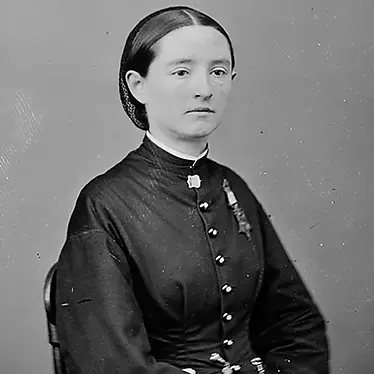

*Mary Edwards Walker was born on November 26, 1832, to Vesta Walker and Alva Walker. Walker’s family persuaded her to pursue further education, which led her to graduate from Syracuse Medical College in 1855. This would make her the second female American doctor in history. She would go to marry another medical student who had opened up a practice in New York, but failed 10 years down the road. As Walker also had progressive views, she kept her maiden name and did not agree to “obey” her husband in the wedding vows; they divorced years later. During the Civil war she wanted to be a surgeon in the army but got denied because of her gender. She then went on to work at a makeshift hospital, wearing non-traditional clothing for better movement. Even though she faced judgment and open hostility for not conforming to gender societal norms, her expertise in medicine surpassed that. She then went on to establish the Women's Relief program. She eventually was able to work in the union on the frontlines as a surgeon, but uncommissioned, and still she kept advocating for herself. The closest she ever got to being truly enlisted would be “Contract assistant surgeon (civilian). Even though she never got enlisted, she did get captured by the Confederate army for a prisoner exchange, where she felt validation from the U.S. army. She would also be the first and only woman awarded the Congressional Medal of Honor. After her medical career, she advocated for women's rights and equality and became a part of the suffrage movement. She also fought for army nurses to receive pensions and fought for dress reform. As a part of the suffrage movement, she believed that the right for women to vote was already in the Constitution; it just needed to be upheld. She broke barriers by attempting to vote but was denied. With her lifelong career, she would be represented on the U.S. quarter program, which was released on June 3rd, 2024. Designed by Phebe Hemphill, the quarter shows Dr. Walker wearing her Medal of Honor and surgeon pins while holding her pocket medical kit.
CELIA CRUZ


Celia Cruz was born on October 21st, 1925, in Havana, Cuba, to Simon Cruz and Catalina Alfonso Ramos. As a young child, her talent was seen early on, from singing lullabies to winning talent contests on radio stations. Her father didn't support her going into the music industry, so instead she became a teacher and sang on the radio and in bands. She then went on to attend the national music conservatory and performed on several radio stations, and even featured regularly on one station. Having a darker complexion, Cruz faced criticism, discrimination, colorism, and sexism, but she overcame them to succeed. Her music career took off when she became the lead singer for the band “La Orquesta Sonoara Matancera,” where they performed all over Latin America and had a hit single go gold, which led Cruz to continue her career in America. Cruz arrived in America in 1961, where, during her 60-year career, she popularized salsa music and became one of the few females to succeed in salsa music, even though it was dominated by males. During her career, she performed salsa music in Spanish to embrace her Afro-Latina heritage during the civil rights movement. She recorded over 70 songs and albums, and most went gold or platinum. As well as winning 5 Grammy awards and receiving the National Medal of Arts. She would go on to be named the queen of salsa and help open people's eyes to Caribbean and Latin music. With Cruz’s legendary career, she would be the first Afro-Latina recognized on U.S. currency, being released on August 5th, 2024. Designed by Phebe Hemphill, the quarter shows Celia Cruz smiling in a rumba salsa dress featuring her catchphrase “AZUCAR”.
ZITKALA-SA


Zitkala Sa was born February 22nd, 1876, on the Yankton Sioux Reservation in South Dakota to Ellen Simmons and Felker Simmons. Her education spanned from Whites' manual labor institute to Earlham College to the New England Conservatory of Music. Later on, she became a teacher at the United States Indian Industrial School. She then went on to become a musician, composer, and author, and dedicated her life to reforming Indian policies. She navigated two worlds: Western society and native american culture, and was against the Americanization of native american people. Sa was also a composer and trained violinist and helped co-write the first native american opera. Zitkala Sa worked rigorously for Indian citizenship rights, tribal sovereignty, and independence. In 1907, she joined the Society of American Indians and was a co-editor of the American Indian magazine. With her significant role in the society of American Indians, she helped influence Congress towards the Indian Citizenship Act and the Indian Reorganization Act. Next, she helped found the National Council of American Indians to help with health care, voting rights, and land rights. Zitkala Sa would then start the Indian Welfare Committee, which was within the general federation of women's clubs. This helped pivot and expand the rights of indigenous women in America. Her work in Washington, D.C., fought for the rights of Indians, worked with Indian organizations, and advocated for full citizenship rights. With her strong advocacy, she was recognized in the U.S. quarter on October 28th, 2024. Designed by Don Everhart, it shows Zitkal Sa with a book representing her advocacy work.